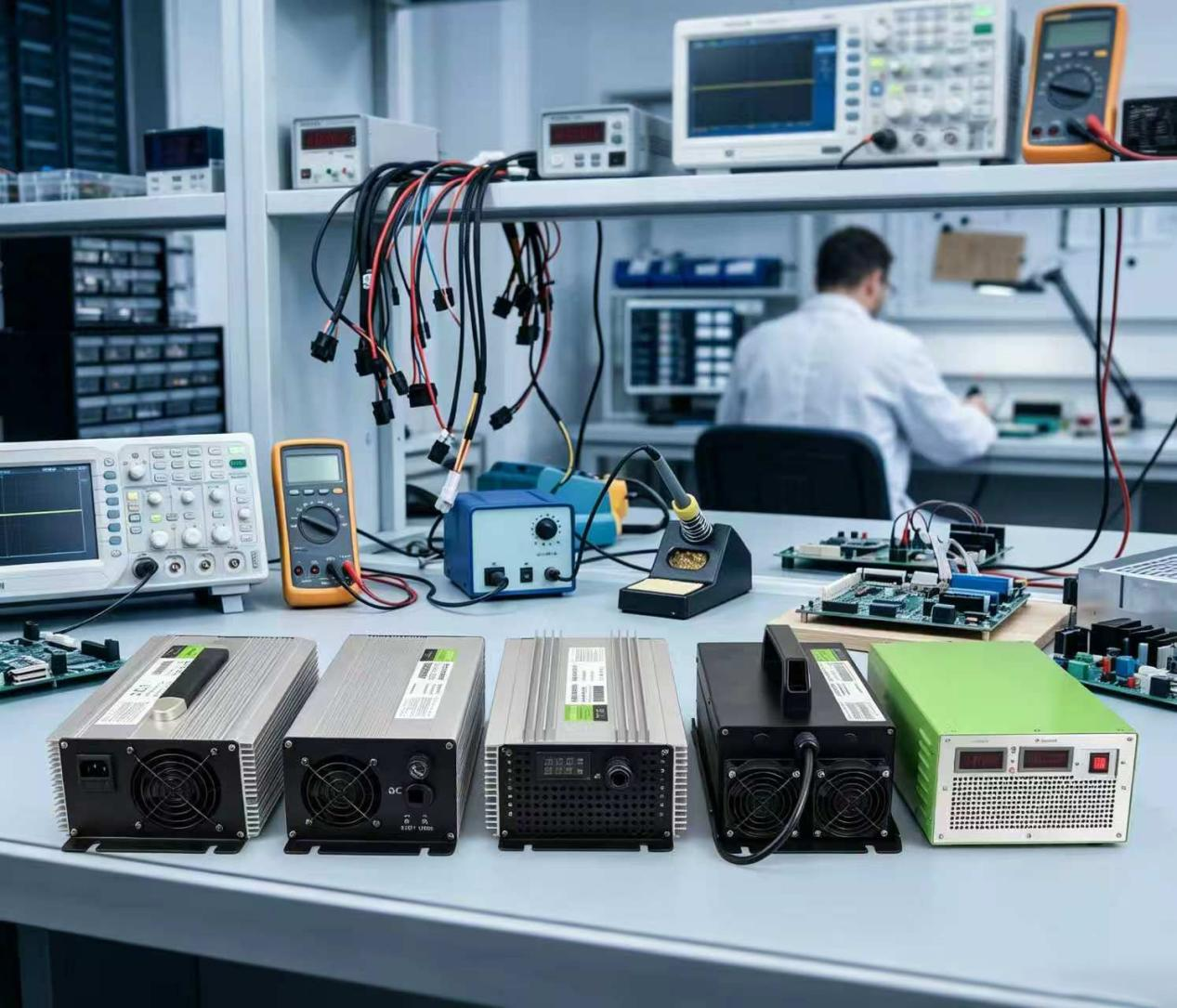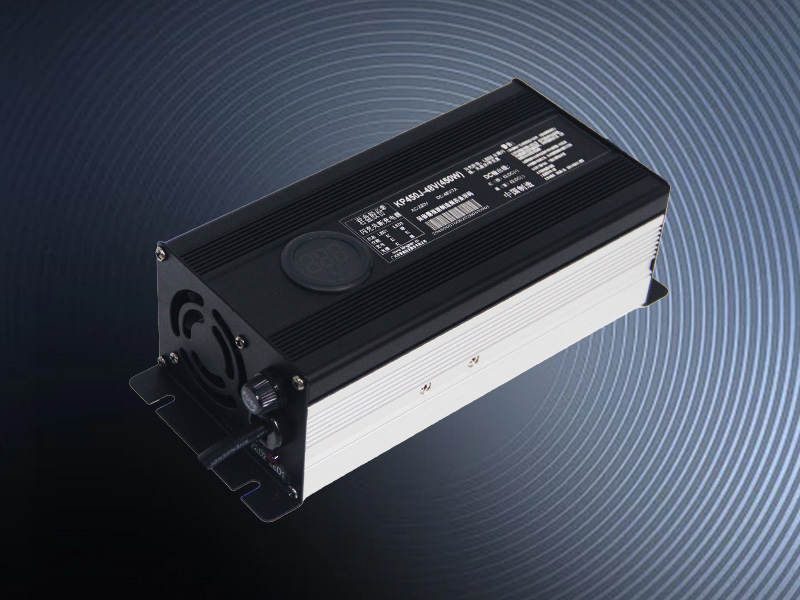
Recently, relying on years of accumulated expertise in power supply R&D, self-developed circuit boards, and continuous charging algorithm iteration, Junpan Industrial officially announced its self-developed core technology — the Variable-Frequency, Variable-Current Flash-Charging Cut-Off Charging Mode.
This technology completely breaks through the limitations of the traditional CC constant-current and CV constant-voltage fixed charging mode that has been used in the industry for over a century. It specifically addresses four major industry pain points: electric vehicle battery fires and explosions, false battery capacity, float charging damage to batteries, and the incompatibility between lead-acid and lithium batteries. It fills the technical gap in civilian electric vehicle charging safety and establishes a unique technological barrier within the industry.
1. Industry Challenges: Structural Defects Inherent in Traditional Charging Modes
At present, most ordinary electric vehicle chargers on the market still use the century-old classic two-stage CC constant-current and CV constant-voltage charging architecture. The charging parameters are fixed and cannot be adjusted according to the real-time electrochemical state of the battery. As a result, long-standing safety and usage problems remain unavoidable. These issues are also the core causes of charging-related fires in residential communities, battery swelling and aging, false battery level displays, and reduced driving range.
- Lead-acid battery chargers:
After the battery is fully charged, there is no effective power cut-off mechanism. Long-term float charging causes the battery to heat up, lose water, and intensify plate sulfation, which can easily lead to swelling, leakage, spontaneous combustion, or explosion. Charging also takes a long time, significantly reducing battery lifespan. - Lithium battery chargers:
These chargers only support software-based power cut-off when fully charged and lack end-stage pulse flash-charging functionality. As a result, voltage differences between cells cannot be balanced. Although the surface voltage may appear normal, the internal battery capacity is not fully replenished. The last bar of battery power is often false capacity. Fast charging may also easily cause lithium dendrite formation, creating hidden risks of short circuits and explosions. - Limited compatibility:
Traditional chargers completely separate lead-acid and lithium battery applications and cannot be used interchangeably. Misuse can directly damage the battery protection board and create serious safety risks. In addition, unstable charging waveforms and high-voltage current directly impact battery cells and plates, causing irreversible structural damage to the battery.
2. Core Breakthrough: Official Explanation of Junpan’s Variable-Frequency, Variable-Current Flash-Charging Cut-Off Technology
Unlike traditional fixed charging logic, Junpan’s Variable-Frequency, Variable-Current Flash-Charging Cut-Off Technology is built around a self-developed variable-frequency PWM control chip. It works together with high-precision sampling circuits, EMI filtering circuits, and closed-loop cut-off circuits.
This system synchronizes positive and negative electrode reactions, ion migration, and electron movement. It prevents charging from exceeding safe limits, ensures smooth electron embedding, and maintains stable circuit operation. The result is a fully dynamic, adaptive, and intelligent charging system that automatically adjusts charging parameters throughout the entire process according to battery internal resistance, temperature, state of charge, and aging condition.
The four core technical modules are as follows:
- Variable-frequency voltage regulation:
Instead of using a fixed switching frequency, the system adopts an adaptive floating frequency range of 15 kHz to 85 kHz. It dynamically adjusts output voltage according to the battery’s discharge level, preventing instant high-voltage impact on the battery and adapting to batteries in different conditions, including new, old, high-temperature, and low-temperature states. - Dynamic current variation:
The system eliminates one-size-fits-all constant-current output. It uses intelligent staged current adjustment throughout the charging process: low-voltage slow charging to activate plates when the battery is deeply discharged, safe fast charging during moderate discharge, and reduced-current balancing near full charge. This prevents violent high-current charging. - End-stage pulse flash charging:
When the battery reaches 90% capacity, the system automatically switches to a gentle pulse waveform. This reduces internal concentration polarization, balances voltage differences between cells, and replenishes deep-level battery capacity. It fundamentally solves the problem of false capacity in the last battery bar and sudden power drops during acceleration, ensuring fuller and more accurate battery capacity. - Four-factor zero-current hardware cut-off:
Unlike the industry’s software-based “pseudo cut-off,” the system verifies four indicators: voltage stability, current compliance, cell balancing, and temperature reduction. Only after these conditions are met does the system cut off the output circuit at the hardware level. This achieves zero micro-current and zero float charging after full charge, completely eliminating the heat and fire risks caused by overnight charging.
3. Technical Advantages: Bidirectional Compatibility with Safety, Fast Charging, and Battery Maintenance
Relying on its full set of self-developed charging algorithms and circuit board architecture, including integrated circuit design for fuse protection, EMI filtering, sampling feedback, temperature control protection, and pulse circuits, this technology achieves breakthrough bidirectional compatibility and breaks charging barriers between battery categories.
- Improved safety:
Lithium batteries gain lead-acid-level protection and stability, enabling fast charging without lithium plating or fire risks. Lead-acid batteries completely avoid float charging, preventing swelling and water loss. This makes the technology suitable for safer indoor and home charging scenarios. - Improved efficiency:
Lead-acid batteries can achieve lithium-battery-level safe fast charging, reducing overall charging time. Lithium batteries benefit from pulse balancing and supplementary charging, allowing every charge to reach 100% actual capacity and eliminating range loss caused by false battery levels. - Battery maintenance and lifespan extension:
The entire charging process uses smooth waveforms without interference noise. Electric charge is steadily embedded into the battery’s active materials, helping repair mild plate sulfation in lead-acid batteries and suppress lithium dendrite formation in lithium batteries. This provides long-term battery maintenance and extends battery cycle life. - One charger for multiple uses:
With a built-in intelligent battery recognition system, the charger can automatically distinguish between lead-acid and lithium batteries and match the appropriate charging curve. One charger is compatible with the two mainstream types of electric vehicle batteries, reducing users’ purchasing costs.
4. Technology Implementation: Fully Self-Developed Production Chain Ensuring Product Quality
This technology is not merely a single algorithm optimization. It is supported by Junpan’s fully self-developed production process. From wire stripping, circuit board component forming, PCB SMT and plug-in assembly, shell drilling, aging testing, to finished product packaging, every process follows standardized quality control.
The technology is specifically matched with a variable-frequency charging circuit structure, optimizing circuit board heat dissipation and anti-interference performance. Every finished charger undergoes comprehensive testing, including high- and low-temperature charging, full-charge cut-off, short-circuit protection, and overload protection, ensuring stable implementation of the technology.
5. Future Outlook
Junpan Industrial has long been deeply engaged in the field of intelligent electric vehicle charging, with a focus on solving industry safety pain points and breaking down technical information barriers.
The mass production and implementation of the Variable-Frequency, Variable-Current Flash-Charging Cut-Off Technology not only marks an iterative breakthrough over the century-old traditional charging mode, but also redefines a new charging standard of “safe fast charging + battery maintenance and protection.”
In the future, Junpan will continue to focus on power supply algorithm R&D and hardware structure optimization. The company will keep launching charging products with higher safety, stronger compatibility, and greater durability, empowering the safe and standardized development of the electric vehicle charging industry and providing more competitive charging solutions for end users and partner distributors.